Due to a hack of the institutional platform, articles prior to No. 28 (2018) are available at https://revistaestudav.usach.cl/. We will let you know when the complete collection is back on OJS.
No. 43 (2025)
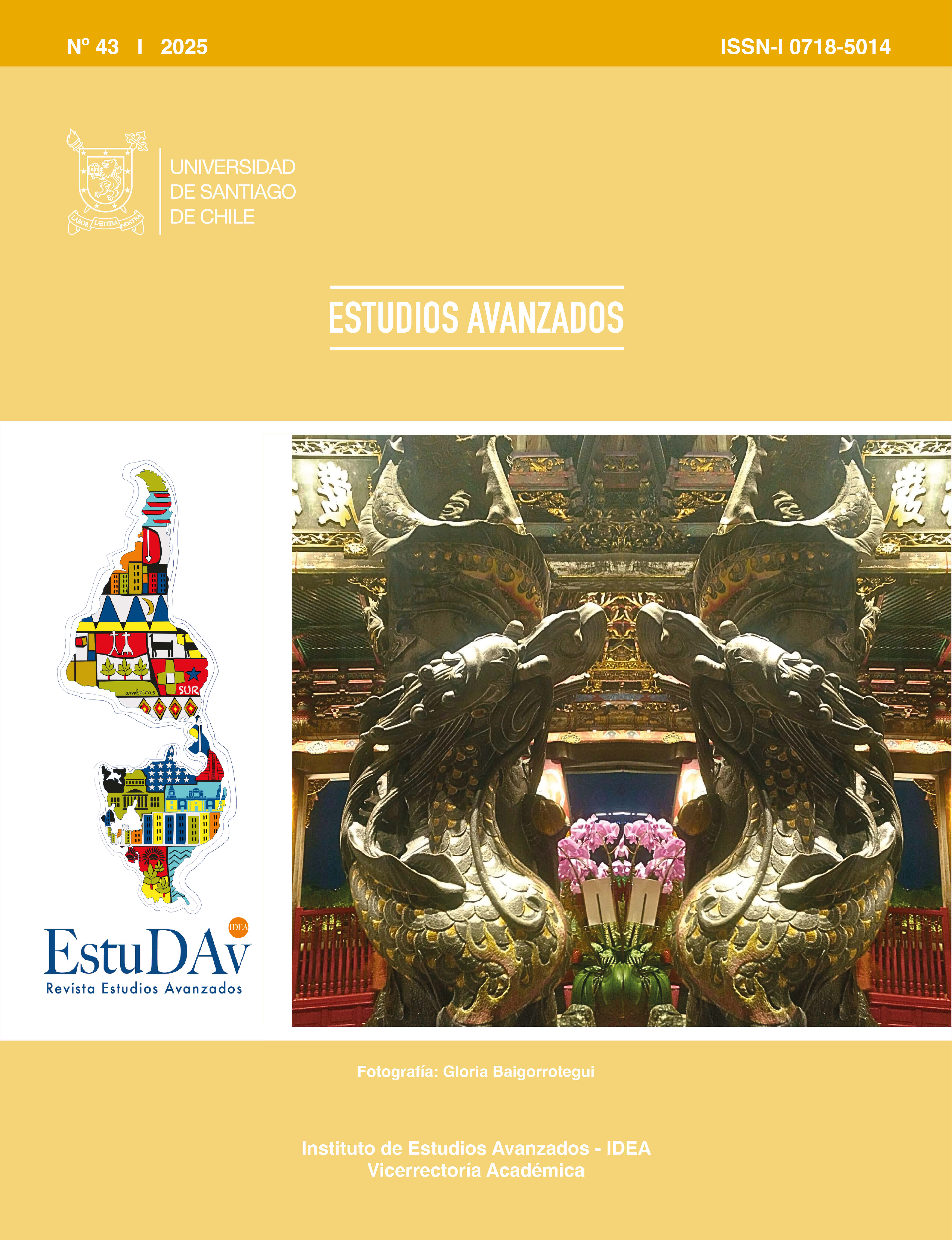
EstuDAv Estudios Avanzados 43 bursts onto the scene with a transregional, interdisciplinary approach spanning South America, the Caribbean, and North America, in connection with Asia. This issue presents the work of PhD Monica DeHart and PhD Carol Chan in the dossier “Transregional Studies: Methodological and Theoretical Proposals for Understanding Historical and Contemporary Relations and Links between Asia and Latin America.” Thanks to this collection of articles and commentaries, methodological and conceptual challenges are raised for addressing interconnected temporalities and geographies in ways that have been largely overlooked until now, whether due to disciplinary dominance, discrepancies within area studies, or the confinement of analyses to national borders.
Thanks to this collection of articles and commentaries, methodological and conceptual challenges are raised for addressing interconnected temporalities and geographies in ways that have been largely overlooked until now, whether due to disciplinary dominance, discrepancies within area studies, or the confinement of analyses to national borders.
Thus, the editors invite us to explore an approach that “expands the geographical frame of reference to consider spaces and processes of encounter, exchange, and negotiation that cross and connect the worlds of the Pacific and the Atlantic.” It brings together scholars from diverse fields—literature, anthropology, history, cultural studies—working with a wide range of materials, including news media (Lynton Cox and Montt), diplomatic encounters (Montt), ethnographic accounts (Chan, DeHart, Lau, and Lynton Cox), and literature (Kim and López-Calvo), to highlight the heterogeneous empirical and epistemological terrain in which transregional interconnections can be traced. With this same spirit, we conclude the miscellaneous section with the work of Consuelo Díaz Muñoz on a novel way of collectively preserving unique and safeguarded trans-memories over time, along with the work of Miryam Fernanda Perret, who presents an interesting focus on the materiality of brick and the ways in which, through its knowledge, ancestry, and records, it is possible to move toward the formation of a people's identity. In short, this final issue of 2025 leads us along the interdisciplinary, relational and multi-scalar paths from which we want to continue welcoming your work in the future, in order to continue expanding knowledge, innovation and critical thinking.
Published:
2025-12-16