The microscope of time: The dancing intercorporality in Andean festive contexts from a visual methodology
DOI:
https://doi.org/10.35588/46w3xf54Keywords:
dance, corporality, emotions, Andean festivals, visual anthropologyAbstract
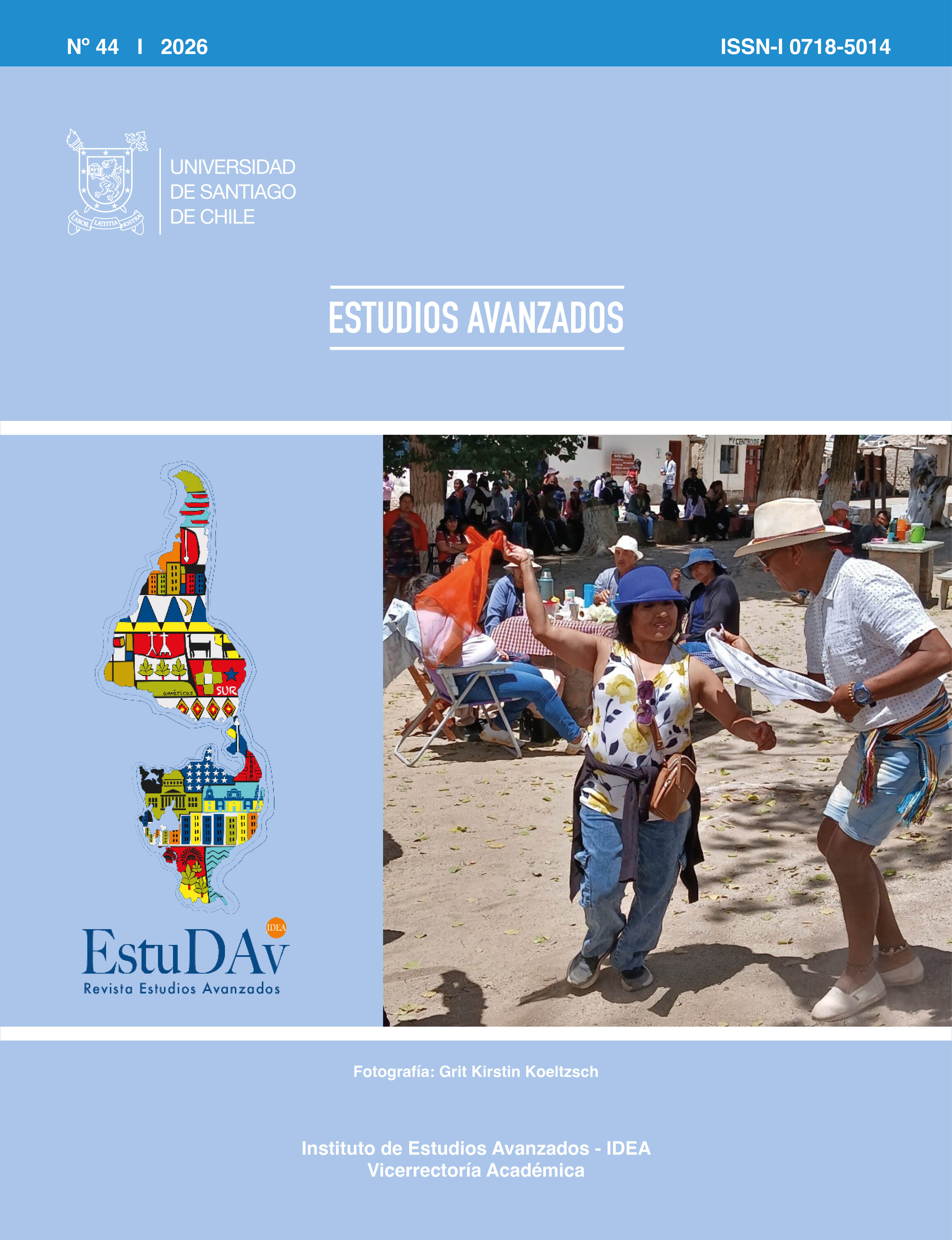
From a sociocultural perspective, dance is considered an embodied social practice that constantly informs us about our perceptions. At the same time, it plays a key role, especially in festive contexts, since it is not only about the coordination of body movements and the deployment of rhythm and steps; it also involves the expression of emotions and the communication of ideas, creating interpersonal relationships by expressing different forms of knowledge. The objective of this article is to explore the corporealities and emotions expressed in dance, applying a visual methodology, and taking as a case study the festivities in Quebrada del Toro, province of Salta, Argentina. The audiovisual constructed and analyzed indicates that the dancing bodies develop their power of critical perception of the way they exist and come to see the world not as a static reality, but as a reality in a process of transformation in time and space.
Downloads
References
Ahmed, S. (2015). La política cultural de las emociones. PUEG-UNAM.
____. (2018). Vivir una vida feminista. Bellaterra.
Banks, M. y Zeitlyn, D. (2015). Visual Methods in Social Research. Sage.
Barbarán, F.R. y Arias, H. (2013). Migraciones humanas en la Quebrada del Toro (departamento Rosario de Lerma, provincia de Salta, periodo 1947-2001). Espacio y Desarrollo, 25, 79-102.
Bateson, G. y Mead, M. (1942). Balinese Character: A Photographic Analysis. New York Academy of Sciences.
Benza Solari, S.E., Mennelli, Y. y Podhajcer, A. (2015). En busca del «nacionalismo auténtico»: Institucionalización de repertorios de danzas folclóricas en Argentina, Bolivia y Perú a mediados del siglo XX. Cuadernos de la Facultad de Humanidades y Ciencias Sociales-UNJu, 47, 135-155.
Blache, M. y Dupey, A.M. (2007). Itinerarios de los estudios folklóricos en la Argentina. Relaciones de la Sociedad Argentina de Antropología (Tomo XXXII, pp. 299-317). Sociedad Argentina de Antropología.
Bloch, E. (1959). Das Prinzip Hoffnung. Suhrkamp.
Block, B. y Kissell, J.L. (2001). The dance: Essence of embodiment. Theoretical Medicine and Bioethic, 22, 5-15. https://doi.org/10.1023/A:1009928504969
Burns, C.A. (2012). Embodiment and embedment: Integrating dance/movement therapy, body psychotherapy, and ecopsychology. Body, Movement and Dance in Psychotherapy, 7(1), 39-54. https://doi.org/10.1080/17432979.2011.618513
Chamosa, O. (2012). Breve historia del folclore argentino 1920-1970: Identidad, política y nación. Edhasa.
Conquergood, D. (1991). Rethinking ethnography: Towards a critical cultural politics. Communication Monographs, 58, 179-194. https://doi.org/10.1080/03637759109376222
Cordero, M. (2014). Precariedad del proyecto disciplinador de la corona e iglesia en el siglo XVIII: Las doctrinas periféricas de la diócesis de Santiago de Chile. En V. Undurraga y R. Gaune (Eds.), Formas de control y disciplinamiento: Chile, América y Europa, siglos XVI-XIX (pp. 143-166). Uqbar e Instituto Riva-Agüero.
Cruz, E.N. y Koeltzsch, G.K. (2022). Between excess and pleasure: The religious festivals of the indigenous people of Jujuy, seventeenth-nineteenth centuries. En J. Jaque Hidalgo y M.A. Valerio (Eds.), Indigenous and Black Confraternities in Colonial Latin America: Negotiating Status through Religious Practices (pp. 273-295). Amsterdam University Press. https://doi.org/10.1515/9789048552351-012
Deren, M. (1946). An Anagram of Ideas on Art, Form and Film. The Alicat Book Shop Press.
____. (1983). Divine Horsemen: The Living Gods of Haiti. McPherson.
____. (2016). About the feminine. Cinema Comparat/ive Cinema, IV(8), 9.
Fals Borda, O. (2015). Una sociología sentipensante para América Latina. Siglo XXI.
Fernandes, C. (2016). Write with dance or we are lost. En S. Quinten y S. Schroedter (Eds.), Tanzpraxis in der Forschung – Tanz als Forschungspraxis: Choreographie, Improvisation, Exploration (pp. 87-97). Transcript.
Flusser, V. (2024). La historia del diablo. Interzona.
Foucault, M. (1976). Vigilar y castigar. Siglo XXI.
Garcés, C.A. (2011). Samilantes, ángeles y enterradores: Estudios de historia cultural. EDIUNJu.
Garfinkel, H. (2006). Estudios en etnometodología. Anthropos.
Kandinsky, V. (2003). De lo espiritual en el arte. Paidós.
Klein, G., Barthel, G. y Wagner, E. (2011). Choreografischer Baukasten. Transcript.
Koeltzsch, G.K. (2019). La economía moral del cuerpo en el Antiguo Régimen hispano-colonial. TEMPUS Revista en Historia General, 10, 1-23. https://doi.org/10.17533/udea.tempus.n10a03
____. (2020). Performance dancística en la cultura popular en el contexto global: Danza y corporalidad en el Noroeste Argentino (NOA). Tesis de doctorado. Universidad Nacional de Jujuy.
____. (2021). Entre comida y baile: El goce corporal en la Fiesta del Haba de Santa Rosa de Tastil (Salta, Argentina). RIVAR, 8(24), 145-164. https://doi.org/10.35588/rivar.v8i24.5188
____. (2025). Dancing through anthropological boundaries: Female artist-ethnographers in the 20th century. Vestnik Antropologii/Herold of Anthropology, 1, 72-90. https://doi.org/10.33876/2311-0546/2025-1
Laban, R. (2011). The Mastery of Movement. Dance Books.
López de Albornoz, C. (1998). Control social y economía colonial tucumana. Las «ordenanzas de buen gobierno» y el conchabo obligatorio a fines del siglo XVIII. Travesía, 1, 63-116.
Merleau-Ponty, M. (1964). The philosopher and his shadow. En R.C. McLeary (Trad.), Signs (pp. 159-181). Northwestern University Press.
____. (1975). Fenomenología de la percepción. Península.
Pink, S. (2011). Digital visual anthropology: Potentials and challenges. En M. Banks y J. Ruby (Eds.), Made to Be Seen: Perspectives on the History of Visual Anthropology (pp. 209-233). The University of Chicago Press.
Raffino, R. (1967). Los petroglifos del ‘Abra Romero’, Santa Rosa de Tastil. Anales de Arqueología y Etnología, XXII, 53-76.
Roda, H.F. (2011). Hombres emplumados: El ritual de la danza de los samilantes. En C.A. Garcés (Ed.), Samilantes, ángeles y enterradores: Estudios de historia cultural (pp. 47-92). EDIUNJu.
Rollwagen, B. (1994). Laban/Bartenieff-Bewegungsstudien. Krankengymnastik. Zeitschrift für Physikalische Therapie, Bewegungstherapie, Massage, Prävention und Rehabilitation, 46, 1196-1212.
Trautmann-Voigt, S. y Voigt, B. (2012). Grammatik der Körpersprache. Ein integratives Lehr- und Arbeitsbuch zum Embodiment. Schattauer Verlag.
Vega, C. (1986). Las danzas populares argentinas. Instituto Nacional de Musicología Carlos Vega.
Vitry, C. (2005). Ocupación inka en la Quebrada del Toro, Salta, Argentina. Xama Unidad de Antropología, 15, 5-19.
Downloads
Submitted
2025-09-24Published
Issue
Section
License
Copyright (c) 2026 Grit Kirstin Koeltzsch

This work is licensed under a Creative Commons Attribution 4.0 International License.