Valorization of heritage and creole vines in the Chilean wine industry
DOI:
https://doi.org/10.35588/gd1pad10Keywords:
Vitis vinifera L., heritage vines, creole vines, Chile, wine productsAbstract
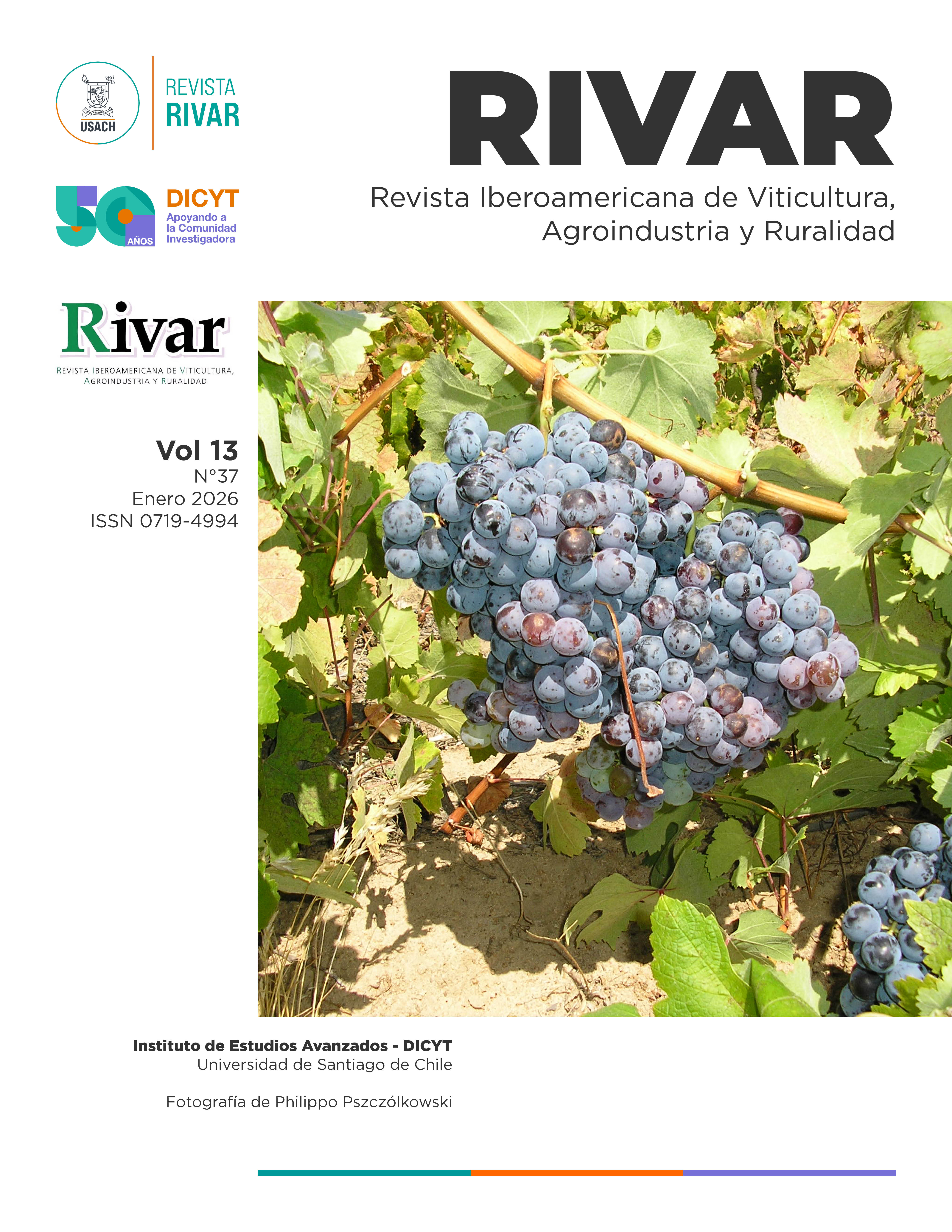
In Chile, creole vines originate mostly from crosses of vines introduced during Spanish colonization, such as Listán Prieto and Moscatel de Alejandría, both recognized as heritage vines. These vines are distributed from the Arica and Parinacota Region to the Araucanía Region, mainly in rainfed areas, and their genetic diversity constitutes an important resource for strengthening the resilience of viticulture in the face of climate change. In the formal and artisanal wine industry, these varieties are used in different products, such as dry and sweet wines, sparkling wines, Pintatani, Chacolí, Chicha, Pipeño, Pajarete, Asoleado, and especially Pisco. Currently, there are initiatives to rescue heritage and criolla vines in the country, which seek to evaluate their oenological potential for commercialization. In this context, heritage and criolla vines represent not only a historical and cultural heritage, but also a strategic resource for a more diversified, resilient, and territorially relevant viticulture, whose study and appreciation are fundamental to addressing the climatic, productive, and identity challenges of the Chilean wine sector. This technical review summarized relevant information on the origin, diversity, and use of heritage and criolla vines in Chile, highlighting their historical value and current potential.
Downloads
References
Aliquó, G., Torres, R., Lacombe, T., Boursiquot, J.M., Laucou, V., Gualpa, J., Fanzone, M., Sari, S., Pérez Peña, J. y Prieto, J.A. (2017). Identity and parentage of some South American grapevine cultivars present in Argentina. Australian Journal of Grape and Wine Research, 23(3), 452-460. https://doi.org/10.1111/ajgw.12282
Baraja Rodríguez, E., Herrero Luque, D. y Martínez Arnáiz, M. (2023). Paisaje y viñedos en la DO «Rueda»: De la diferenciación a la singularidad. Boletín de la Asociación de Geógrafos Españoles, 98, 1-33. https://doi.org/10.21138/bage.3492
Castro San Carlos, A. (2016). Chicha y sidra de manzana en Chile (1870-1930): Manzanas con identificación de origen. RIVAR, 3(9), 4-26.
Castro San Carlos, A., Mujica, F. y Argandoña, F. (2015). Entre Pintatani y Codpa: Paisaje y productos típicos en los relatos campesinos, 1847-2013. RIVAR, 2(6), 70-86.
Cejudo-Bastante, M.J., del Barrio-Galán, R., Heredia, F.J., Medel-Marabolí, M. y Peña-Neira, Á. (2018). Location effects on the polyphenolic and polysaccharidic profiles and colour of Carignan grape variety wines from the Chilean Maule region. Food Research International, 106, 729-735. https://doi.org/10.1016/j.foodres.2018.01.054
Gutiérrez-Gamboa, G. y Fourment, M. (Eds.). (2024). Latin American Viticulture Adaptation to Climate Change. Perspectives and Challenges of Viticulture Facing up Global Warming. Springer. https://doi.org/10.1007/978-3-031-51325-1
Gutiérrez‐Gamboa, G., Liu, S.Y. y Pszczólkowski, P. (2020). Resurgence of minority and autochthonous grapevine varieties in South America: A review of their oenological potential. Journal of the Science of Food and Agriculture, 100(2), 465-482. https://doi.org/10.1002/jsfa.10003
Gutiérrez-Gamboa, G. y Moreno-Simunovic, Y. (2019). Terroir and typicity of Carignan from Maule Valley (Chile): the resurgence of a minority variety. OENO One, 53(1), 75-93. https://doi.org/10.20870/oeno-one.2019.53.1.2348
Jorge-Martín, R. y Fernández Portela, J. (2024). Situation and recent changes in quality and internationalization in the DO Bierzo: The territory as added value for export survival. Boletín de la Asociación de Geógrafos Españoles, 100, 1-34. https://doi.org/10.21138/bage.3384
Lacoste, P., Castro, A., Briones, F., Cussen, F., Soto, N., Rendón, B., Mujica, F., Aguilera, P., Cofré, C., Núñez, E. y Adunka, M. (2015a). Vinos típicos de Chile: Ascenso y declinación del chacolí (1810-2015). Idesia, 33(3), 97-108. https://doi.org/10.4067/s0718-34292015000300014
Lacoste, P., Castro, A., Briones, F. y Mujica, F. (2015b). El pipeño: Historia de un vino típico del sur del Valle Central de Chile. Idesia, 33(3), 87-96. https://doi.org/10.4067/s0718-34292015000300013
Lacoste, P., Pszczólkowski, P., Briones, F., Aguilera, P., Mujica, F. y Garrido, A. (2015c). Historia de la chicha de uva: Un producto típico en Chile. Idesia, 33(2), 87-96. https://doi.org/10.4067/s0718-34292015000200011
Lanino-Alar, M. (2019). Vino del Desierto: Una oportunidad para recuperar una tradición de la agricultura del desierto. Idesia, 37(2), 3-4. https://doi.org/10.4067/s0718-34292019000200003
Meneses, M., Castro, M.H. y Hinrichsen, P. (2024). Genetic characterization of Criolla and European grapevines recently found in Chile: A key step for Their Rescue and Conservation. Australian Journal of Grape and Wine Research, 2024, 4817877. https://doi.org/10.1155/2024/4817877
Mendoza, K., Aliquó, G., Prieto, J.A., Blas, R., Torres, J., Casas, A., Grados, M., Aybar, L. y Torres, M. (2022). Prospection and identification of traditional-heritage Peruvian grapevine cultivars (Vitis vinifera L.) from Ica and Cañete valleys. Vitis, 61, 47-51. https://doi.org/10.1051/bioconf/20235601004
ODEPA (21 de diciembre de 2022). Estudio para el desarrollo de un catastro de variedades tradicionales de nuestro país y de sus guardadoras y guardadores. Oficina de Estudios y Políticas Agrarias, del Ministerio de Agricultura, Gobierno de Chile. https://www.odepa.gob.cl/publicaciones/estudios/estudio-para-el-desarrollo-de-un-catastro-de-variedades-tradicionales-de-nuestro-pais-y-de-sus-guardadoras-y-guardadores
Peña-Neira, A. (Coord). (2016). Rescate de cepas patrimoniales y recuperación del potencial productivo de vino Pintatani en el Valle de Codpa, Región de Arica y Parinacota. PYT-2016-0350. Ministerio de Agricultura, Observatorio para la Innovación Silvoagropecuaria y la Cadena Agroalimentaria y Fundación para la Innovación Agraria. https://opia.fia.cl/601/w3-article-78263.html
ProChile (18 de diciembre de 2023). Proyecto para Valle del Itata de ProChile permitió que 39 empresas realizaran exportaciones de vino entre 2021 y 2023. ProChile. https://www.prochile.gob.cl/noticias/detalle-noticia/2023/12/18/proyecto-para-valle-del-itata-de-prochile-permiti%C3%B3-que-39-empresas-realizaran-exportaciones-de-vino-entre-2021-y-2023
Pszczólkowski, P., Ganga, M.A., Véliz, L., Castro, M.H., Meneses, M., Castro, A., Cañón, P. y Hinrichsen, P. (2022). Molecular and ampelographic characterization of genotypes used for Pajarete wine, an old Denomination of Origin from Huasco and Elqui Valleys in northern Chile. Vitis, 61(1), 37-44.
Pszczólkowski, P. y Lacoste, P. (2016). Variedades criollas, una oportunidad para el pisco de Chile. Revista de la Facultad de Ciencias Agrarias Universidad Nacional de Cuyo, 48(1), 239-251.
Reyes Muñoz, M. y Lladser Urzúa, J. (2024). Recovering the Asoleado: A heritage of the rainfed of Maule Valley. En G. Gutiérrez Gamboa y M. Fourment (Eds.), Latin American Viticulture Adaptation to Climate Change (pp. 103-116). Springer.
Sotomayor, J.P. (22 al 27 de noviembre de 1987). Denominación de Origen: Vino Asoleado y Pajarete. En I Simposio Internacional sobre Denominación de Origen de productos vitivinícolas en América Latina (Tomo 1, pp. 298-313). La Serena, Chile.
Downloads
Submitted
2024-11-13Published
Issue
Section
License
Copyright (c) 2025 Philippo Maria Pszczolkowski, Gastón Gutiérrez, Pablo Cañón

This work is licensed under a Creative Commons Attribution 4.0 International License.