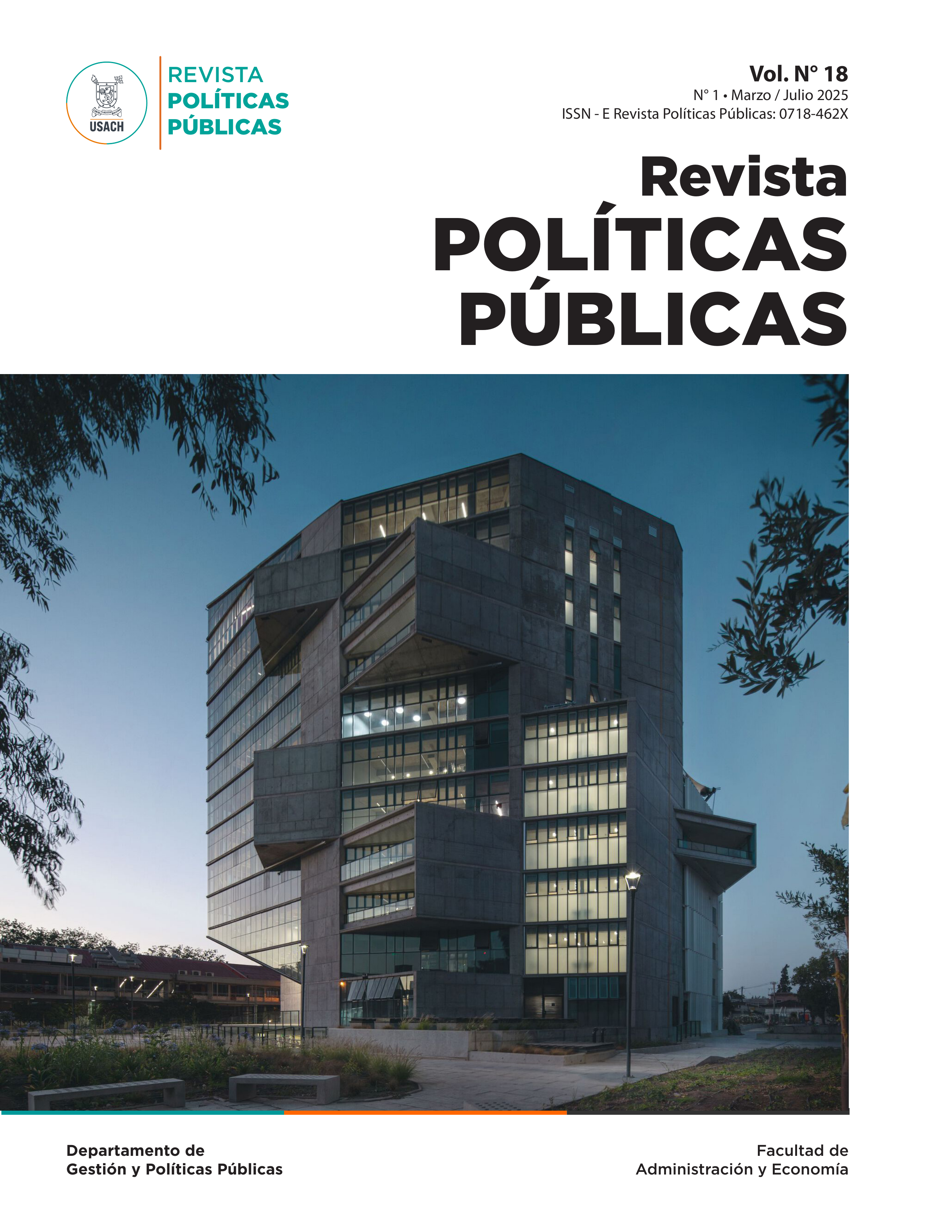
Data and governance: Hyper-densification, environmental crisis, and information gaps based on the case of Estación Central, Chile
DOI:
https://doi.org/10.35588/65n3ts61Keywords:
hyper densification, Data governance, Urban sacrifice zone, Evidence based planificationAbstract
The swift urban transformation of Estación Central county driven by real estate hyper-densification and recent migration, poses critical challenges for sustainable planning under SDG 11. This essay analyzes the scenario during the first months of implementation of the first Communal Regulatory Plan 2025, arguing that while this instrument fills historical regulatory gaps, it lacks the metropolitan articulation required to manage complex phenomena transcending communal borders. Through three axes—data management, environmental sustainability, and public security—the study examines how the absence of local information hinders the correct estimation of service demand, resulting in operational collapses and public space degradation that new regulations cannot retroactively reverse. The article concludes on the urgent need for multi-level governance systems and evidence-based decision-making to transition from crisis containment to territorial intelligence.
Downloads
References
• Chile. (2024). Ley N.º 21.663, ley marco de ciberseguridad (Biblioteca del Congreso Nacional). https://www.bcn.cl/leychile/navegar?idNorma=1202434
• Cienfuegos, I., Penaglia, F., & León, J. (2024). Diagnóstico de la gestión municipal en Chile: Evidencia desde la percepción de actores clave. Revista de Administração Pública, 58(1), e2022-0378. https://doi.org/10.1590/0034-761220220378
• Del Río, M. V. (2017). Impact of intensive residential densification in Santiago’s urban fabric segmentation: A quantitative standpoint. Revista 180, (40), 78–93.
• Del Solar, M. J. (2025, 8 de mayo). Criminalidad en Chile: Dinámicas regionales (Boletín Regional N.º 43). Faro UDD. https://faro.udd.cl/files/2025/05/br-43-delitos.pdf
• Instituto Nacional de Estadísticas. (2024). Estimaciones y proyecciones de población 2002–2035 por comuna y área urbano-rural [Base de datos]. https://www.ine.gob.cl
• Instituto Nacional de Estadísticas. (2025). Censo 2024: Resultados. https://censo2024.ine.gob.cl/
• Kozak, D. (2018). Revisitando el debate sobre la fragmentación urbana: Una década y media después de “Splintering Urbanism”. Revista Iberoamericana de Urbanismo, (14), 15–22.
• Mills, D., Pudney, S., Pevcin, P., & Dvorak, J. (2021). Evidence-based public policy decision-making in smart cities: Does extant theory support achievement of city sustainability objectives? Sustainability, 14(1), Article 3. https://doi.org/10.3390/su14010003
• Ministerio de Ciencia, Tecnología, Conocimiento e Innovación. (2025). Actualización de la Política Nacional de Inteligencia Artificial (Decreto N.º 12). Biblioteca del Congreso Nacional de Chile. https://www.bcn.cl/leychile/navegar?idNorma=1210664
• Muñoz Vallejos, F. (2024). Zona de sacrificio urbano: Cómo la explosión inmobiliaria, demográfica y migratoria transformó Estación Central [Tesis de magíster, Universidad de Santiago de Chile].
• Orellana, A., Vicuña, M., Link, F., Perrozzi, A., Marshall, C., Truffello, R., & Señoret, A. (2022). Verticalization and socio-spatial configuration of Santiago. AUS, (31), 31–39. https://doi.org/10.4206/aus.2022.n31-05
• Pacheco-Vega, R. (2020). Environmental regulation, governance, and policy instruments, 20 years after the stick, carrot, and sermon typology. Journal of Environmental Policy & Planning, 22(5), 620–635. https://doi.org/10.1080/1523908X.2020.1792862
• Ramos Zincke, C. (2016). La producción de la pobreza como objeto de gobierno. Ediciones Universidad Alberto Hurtado.
• Repette, P., Sabatini-Marques, J., Yigitcanlar, T., Sell, D., & Costa, E. (2021). The evolution of city-as-a-platform: Smart urban development governance with collective knowledge-based platform urbanism. Land, 10(1), Article 33. https://doi.org/10.3390/land10010033
• Rojas, L. (2020). Ciudad vertical: La nueva forma de la precariedad habitacional. Comuna de Estación Central (2008–2018).
• Rojas, L. (2022). El negocio del habitar: Gobernanza interna de las torres de Estación Central, Santiago de Chile. Revista INVI, 37(105), 45–70. https://doi.org/10.5354/0718-8358.2022.63796
• Sabatini, F., Rasse, A., Cáceres, G., Robles, M. S., & Trebilcock, M. P. (2017). Promotores inmobiliarios, gentrificación y segregación residencial en Santiago de Chile. Revista Mexicana de Sociología, 79(2), 229–260.
• Steenmans, K., Robin, E., Acuto, M., Iwaszuk, E., & Garza, L. O. (2023). Governing the informed city: Examining local government strategies for information production, consumption and knowledge sharing across ten cities. Urban Governance, 3(4), 243–251. https://doi.org/10.1016/j.ugj.2023.09.001
• Vergara, J., & Asenjo, D. (2019). Arquitectura y densidad: Controversias en torno a los edificios de altura: El caso de Santiago de Chile. Revista de Arquitectura, 24(36), 32–39. https://doi.org/10.5354/0719-5427.2019.53771
• Vicuña del Río, M. (2020). Densidad y sus efectos en la transformación espacial de la ciudad contemporánea: Cinco tipologías para interpretar la densificación residencial intensiva en el Área Metropolitana de Santiago. Revista 180, (45), 112–126.
• Vicuña, M., Orellana, A., Truffello, R., & Moreno, D. (2019). Integración urbana y calidad de vida: Disyuntivas en contextos metropolitanos. Revista INVI, 34(97), 17–47.
• Wilson, J. Q., & Kelling, G. L. (1982). Broken windows: The police and neighborhood safety. Atlantic Monthly, 249(3), 29–38.
• Yan, Y., Jaung, W., Richards, D. R., & Carrasco, L. R. (2022). Where did the ecosystem services value go? Adaptive supply, demand and valuation of new urban green spaces. Resources, Conservation and Recycling, 187, Article 106616. https://doi.org/10.1016/j.resconrec.2022.106616
• Yang, Y., Jiang, L., Ma, X., Liu, S., & Wang, L. (2025). A comprehensive approach to identifying the supply and demand of urban park cultural ecosystem services in the megalopolis area of Shanghai, China. Land, 14(3), Article 455. https://doi.org/10.3390/land14030455